

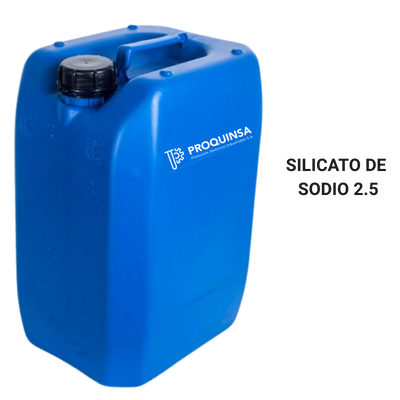

Sodium Silicate 2.5
Chemical Formula Na2O.XSiO2 + H2O
Abstract
Liquid Sodium Silicates are solutions in water, manufactured from varying proportions of Sodium Oxide (Na2O) and Silicon Oxide (SiO2).



Description
Sodium silicates are produced by melting sodium carbonate (Na2CO3) with specially selected silica sand at high temperatures. The resulting product is an amorphous crystal that can be dissolved by special processes to produce solutions in a wide variety of forms.
Composition
Table
| Ingredients | Synonym | Nº CAS | % | EC Nº |
|---|---|---|---|---|
| Sodium Silicate | Sodium Salt of Silicic Acid | 1344-09-8 | 36.00 – 47.0 | 215-687-4 |
| Water | Balance |
Applications
In the detergent industry:
-
Increased wetting: One of the first steps in the washing process is wetting. Sodium silicate reduces surface tension, which facilitates this process.
-
Emulsification: Silicates help disperse grease stains (generally acidic), suspending them in the wash solution and preventing them from redepositing.
-
Deflocculation: They promote the breakdown of inorganic particle stains (dirt, sand, etc.), dispersing them in the water and preventing them from regrouping.
-
Alkalinity: Sodium oxide increases alkalinity in the washing process.
-
Buffering: It has a buffering effect that helps maintain a high pH in the presence of acidic dirt. Sequestering and softening power: Silicates react with the ions in the water, generating compounds that are rinsed away, removing minerals and water hardness.
In the ceramics industry:
-
They are used as deflocculants in the manufacturing process of stoneware and other mineral products.
-
They reduce the viscosity of slips to facilitate pumping and processing. Adding sodium silicates contributes to good rheological behavior of the slip by providing ions that modify the surface charge of the clay particles, decreasing the force of attraction between them and thus reducing viscosity. In this way, fluids with a higher percentage of solids can be prepared, making them easier to transport.
In water treatment:
-
Sodium silicates are one of the substances approved by the EPA (Environmental Protection Agency) to reduce the lead, copper, and other heavy metal content in drinking water. Acting as corrosion inhibitors, silicates form a microscopic film inside pipes, preventing rust particles from being released into the system. Unlike other corrosion inhibitors, sodium silicates do not add phosphates or zinc to water sources.
-
When compared to phosphate-based corrosion inhibitors, sodium silicates have beneficial effects on pH. When added in appropriate amounts, sodium silicate can raise the system’s pH to the alkaline range, a practice widely recommended for reducing lead contamination in municipal water systems.
-
In wastewater management, silicates are used as flocculant agents.